
Prophet Muhammad (PBUH): Our Guiding Light for Unity and Collective Action
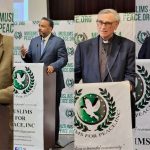
The 19th Annual Prophet Muhammad (PBUH) Interfaith Conference, hosted by Muslims4Peace, successfully gathered 400+ attendees from diverse backgrounds to explore the Prophet’s example as a universal source for unity and collective action. The event was moderated by Dr. Mehdi Husaini. The program centered on translating core Islamic principles into practical solutions for contemporary humanitarian issues, specifically addressing the urgent need to support the oppressed in Gaza.
Key Takeaways and Speaker Insights
1. The Core Principle of Unity and Accountability
Hajj Hassanain Rajabali delivered a powerful address emphasizing the divine principle of unity among all humanity, drawing from the Quran’s account of Adam and Eve’s creation.
- Rejection of Bigotry: Rajabali likened the devil’s refusal to bow to Adam—driven by arrogance and a sense of superiority—to modern-day racism and bigotry (7:10).
- Accountability: He stressed that belief in God and the Day of Judgment creates accountability for one’s actions (12:35), advocating that people must reject discord and unite for humanity’s sake (25:21).
- Legacy of Islam: He emphasized that Islam’s message originated with Adam (18:01) and was completed by Prophet Muhammad, urging the audience to engage in politics and stand up for justice.
2. Local Engagement as a Foundation for Global Peace
Sami Shaban highlighted the urgency of action, stating, “the time is now” (2:15). He emphasized that advocacy for peace in Gaza is compatible with political success, urging the audience to integrate social justice with the Palestinian cause.
- Personal Connection to Crisis: Drawing on his journey as an immigrant raised by a single mother from Gaza and his experience of losing 43 family members in the region (5:05), Shaban underscored the widespread affordability and hunger crisis in America.
- Local Action, Global Impact: He advocated for local community engagement (6:19), arguing that peace in Gaza starts with addressing local issues like hunger and education, which helps cultivate allies for peace advocacy (6:55).
- Political Mobilization: Shaban lauded the formation of the New Jersey Muslim Coalition (uniting 40+ mosques), which spearheaded the “uncommitted movement,” garnering nearly 47,000 votes (8:15) to signal dissatisfaction with current leadership. He concluded by urging the community to move from the “backseat to the driver’s seat” (11:39) in local political races.
3. Morality, Resilience, and Interfaith Solidarity
The conference featured diverse voices demonstrating the universal relevance of the Prophet’s character:
- Dr. Mehdi Husaini focused on the Prophet’s legacy of resilience and good character in delivering God’s weighty message. He cited the historical example of Muslim refugees finding common ground with Najashi, the Christian King, who told the Muslims that “all God-loving people are one.”
- Dr. Reverend Shannon Smythe framed Jesus as a grassroots peace organizer whose nonviolent ministry rigorously resisted dehumanization. She drew inspiration from the Princeton Gaza Solidarity encampment as a vision of interfaith resistance and true peace against systems of injustice.
- Rev. Roberto Fois offered three principles for peace:
- Peace must be made with your enemies.
- Peace requires the active harm to stop.
- Harm stops when we recognize the humanity of our enemies. He reinforced Dr. Martin Luther King Jr.’s assertion that “there can be no justice without peace, and there can be no peace without justice.”
- Dr. Mark Pepper spoke about his personal journey, noting that his successful upbringing helped him to question his previous unconditional support for Israel. He stated that current atrocities are being “inappropriately used as an excuse” to commit current actions against the Palestinians, urging attendees to look beyond denial.
- Somayah Elsamra (educator and former BOE candidate) shared three key lessons from her community engagement: Muslims must take an active role in serving the needy; disengaging from elections has real consequences; and youth must be centered in leadership.
Community Service and Leadership Awards
The conference celebrated individuals dedicated to community and justice:
|
Award Recipient
|
Award Title
|
Citation
|
|
Zainab Syed
|
2025 MFP Community Service Award
|
Inspiring us to build a peaceful community. Zainab is a dedicated public servant and Communications Officer at the Office of Faith-Based Initiatives, noted for fostering dialogue, civic inclusion, and founding the NJ Muslim Heritage Month Coalition.
|
|
Ali-Ahmed Shah
|
2025 MFP Youth Leadership Award
|
Empowering Communities, Inspiring Generations. Ali-Ahmed is a Supply Chain professional (SpaceX/Starlink), MBA candidate, and the Founder of the New Jersey Sports League (NJSSL), a 501(c)(3) dedicated to community building through sport.
|
The event concluded by reinforcing the need for perseverance, reminding the audience that “the help of God is near”(27:07) for those who unite on principles of morality and justice. Dinner was served to all attendees.





 Interfaith Conference Report)